Risk Education and Mines/Explosives Detection Improvement Strategies
- Project Code: REMEDIS
- Start Date: October 1, 2026
- End Date: September 30, 2030
- Reference: N/A
- Funding: Horizon CL3-2025-01 (European Commission)
- Royal Military Academy Involvement: Partner
Team
- Coordinator: Emile Lebrun (T4T), Maria Garcia Fernandez (UO)
- Coordinator Affiliation: Tech 4 Tracing, Universidad De Oviedo (UO)
- Project Co-promotor: Hannes De Meulemeester
- RMA Researchers: Aron Debruyn
- Project Partners (RMA): Department of Mathematics (MWMW)
- Project Partners (BE-DEF): N/A
- Project Partners (Other): Tech 4 Tracing, Universidad De Oviedo (UO), Postup Foundation, HALO Trust, SOAS University of London, Interregional Center for Humanitarian Demining and Rapid Response of the State Emergency Service of Ukraine, National University «Kyiv Aviation Institute»
Context
Landmines and unexploded ordnance remain a major obstacle to the safe return of contaminated land to civilian use. The challenge is particularly acute in Ukraine, where large areas are potentially hazardous and humanitarian mine action operators must deal with a wide variety of threats, environments and operational constraints. Current detection approaches still suffer from missed threats, false alarms, limited survey speed and high operational costs, while the large number of organisations involved creates an additional need for harmonised procedures, training and reporting. At the same time, explosive ordnance risk education remains essential for reducing civilian casualties while the environment remains contaminated.
Objectives
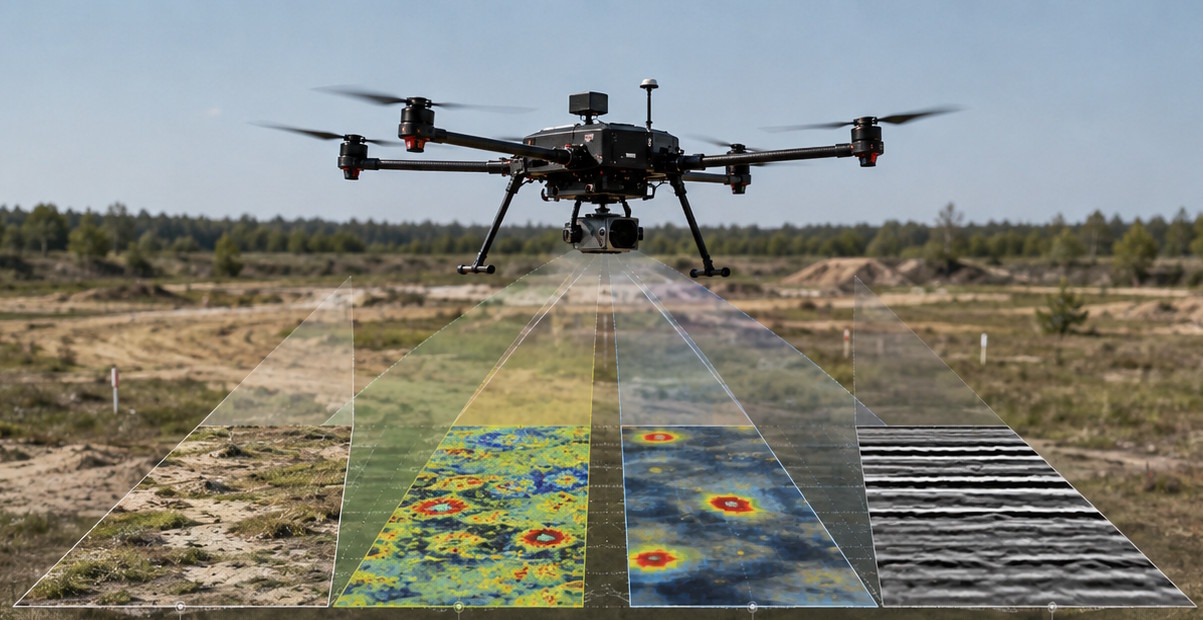
REMEDIS aims to improve the effectiveness, safety and cost-efficiency of humanitarian mine and UXO detection by developing and validating multi-sensor remote sensing solutions for technical survey. The project will investigate complementary sensing technologies including visible and infrared imaging, multi- and hyperspectral imaging, magnetometry and ground-penetrating radar, and determine how these sensors can best be combined at different levels of cost and operational complexity. The project will also translate the resulting technical knowledge into best practices, standardised procedures, decision-support tools and training curricula for humanitarian mine action operators. In parallel, REMEDIS will improve explosive ordnance risk education by identifying effective behaviour-change approaches, evaluating different delivery methods and developing transferable guidance for Ukrainian and European stakeholders.
Methodology
The technical work will start from an assessment of current technologies, user experience and operational requirements in Ukraine, followed by controlled evaluations of individual sensors and multi-sensor combinations. Optical, multi- and hyperspectral, magnetic and GPR measurements will be processed independently and then fused within a common georeferenced 3D representation of the surveyed area. Different fusion and AI-based detection approaches will be compared using quantitative measures such as detection probability, false-alarm rate, processing speed and operational complexity. Promising sensor combinations will be integrated on UAV platforms and validated iteratively in controlled and close-to-real-world environments. The resulting performance data will be used to develop guidelines, training curricula, standard operating procedures and a reusable data repository. In parallel, the risk education component will combine surveys, behavioural studies, community co-design and pilot interventions to establish evidence-based EORE methods and policy recommendations.